
Alberta Water Quality Awareness (AWQA) is a province-wide program focused on increasing people’s awareness and understanding of water quality and watershed health, through hands-on water quality testing.
AWQA participants use water quality test kits to get outside and explore the health of their local waterways. Using their test kits, participants gather basic information about the health of Alberta’s surface waterbodies and then contribute what they find to our online database and watershed map.
Why is water monitoring important?
Increasing demands placed on waterbodies in our province together with the threat of pollution and environmental damage has made water management increasingly important. The first step to effective management is improved knowledge and awareness.
By participating in this province-wide community monitoring event, Albertans are:
- Gaining an understanding of the health of their local waters
- Working together to create a province-wide snapshot of basic water quality
- Helping to build an ethic of stewardship and water protection
- Becoming involved in their watersheds at a local level
- Getting outside and having fun while exploring the health of our watersheds
Water Quality Test Kits
The AWQA Day test kits provide the materials to test four basic measures of water quality:
– temperature
– dissolved oxygen
– pH
– turbidity
These water quality characteristics may have important implications for fish and wildlife habitat, outdoor recreation and human health. The test kits can be used to test any stream, lake, river, wetland, dugout, pond, slough or other surface waterbody in Alberta.
Sharing Results
 AWQA Day participants submit the water quality information they collect to a watershed map and online database to share with others. Together, everyone that participates in AWQA Day is illustrating a common interest among many Albertans to be involved in their watersheds, while creating a province-wide snapshot of water quality.
History
AWQA is modeled after the highly successful World Water Monitoring Challenge (WWMC), a program created and coordinated by America’s Clean Water Foundation. WWMC began in 2002 as part of an effort to connect people personally with efforts to protect and preserve their local watersheds. In addition, WWMC provides a means of building information on the health of water resources over time.
AWQA follows the same format as WWMC and capitalizes on the existing knowledge and interest of many Albertans to help introduce water monitoring to others who have an interest in learning more about their local watershed.
We encourage everyone to get involved, take a personal stake in water management and to get outside and have fun!

 The members of the steering committee will continue to play a strong role in facilitating and tracking implementation actions. This includes any actions they were responsible for, as well as tracking other committees and sector’s actions and progress made towards achieving the plan’s outcomes. Ongoing communication is essential to successful implementation and achieving outcomes, therefore a regular reporting mechanism could be set up in order to provide regular evaluation of the plan.
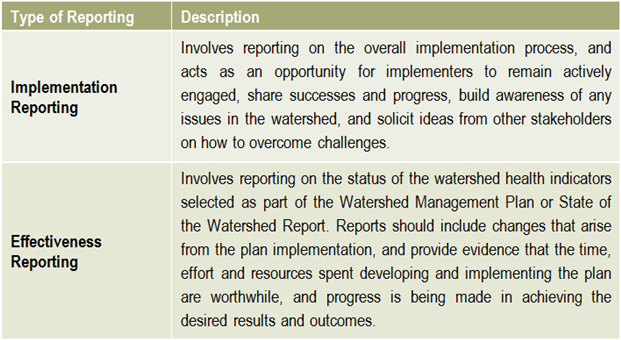 Reporting is an essential component of any watershed management planning and implementation process. There are two main types of reporting that should be shared with stakeholders on a regular basis: implementation reporting & effectiveness reporting.
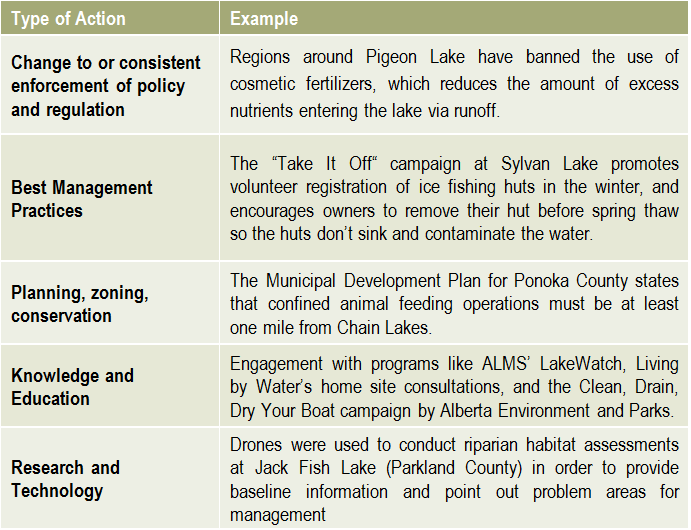 There is no limit to the number or types of lake management actions, but they typically fall into the categories on the right.
 Helpful resources
 The development of a lake watershed management plan provides the guidance needed to implement activities, but the plan cannot be static. Monitoring the performance of your management actions is essential to understanding whether your goals have been met, and whether further actions are needed. Monitoring and evaluating the implementation and effectiveness of a lake watershed management plan allows assessment of progress towards the goals and objectives of the plan, identification of problems and opportunities, and a collection of critical information required when performing a 5 or 10 year review of the plan.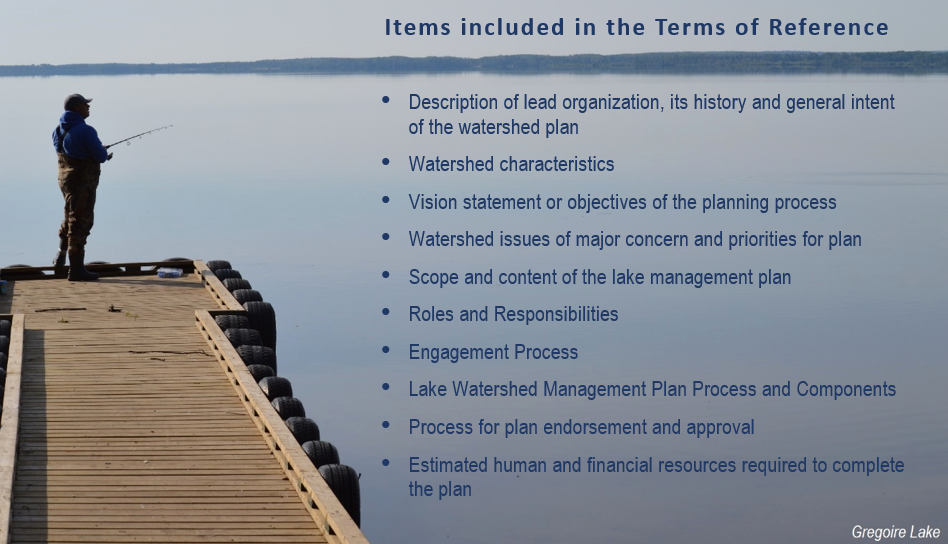
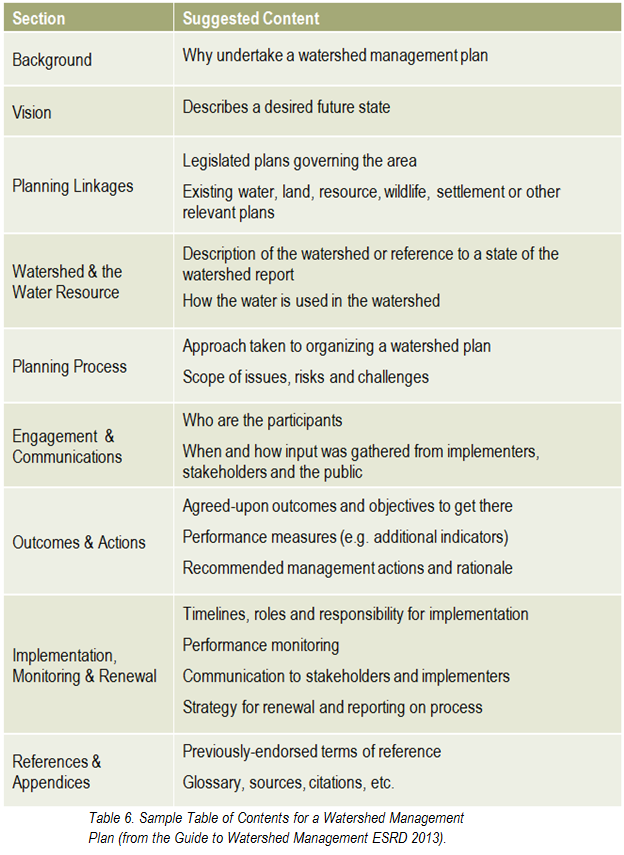
 What has the monitoring results of the plan and of the indicators shown? Is there a need to modify the plan? It is important that the lake watershed management plan does not just sit on a shelf. Information gaps should be addressed, action items need to be managed, completed, and evaluated to best address the needs of the lake. Always keep in mind the vision: if the actions taken are not bringing the lake closer to that vision, then the plan needs to be modified. Consider updating both the state of the watershed and the lake watershed management plans at regular intervals to make sure that the actions taken were achieving the desired outcomes and to evaluate what work still needs to be done.
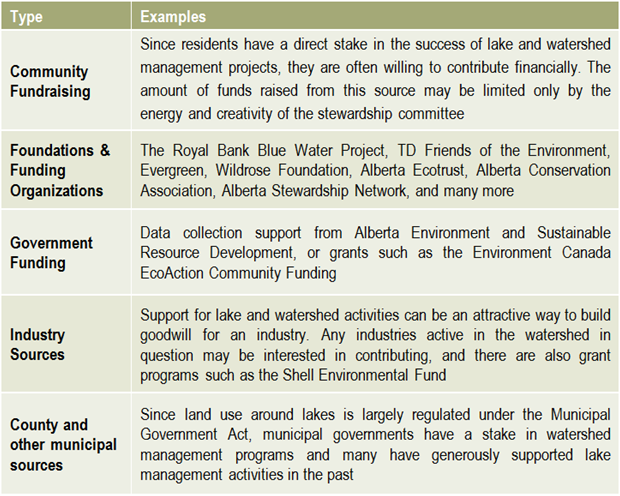 Once a plan has been approved by all affected sectors and officially endorsed and released by the steering committee, then implementation can begin in full. Action projects can be large and comprehensive, or made smaller by staging projects over time or into modules that can be tackled one at a time. Fundraising is an issue that many community groups may find intimidating, but experience with programs such as the Pine Lake Restoration Program (see
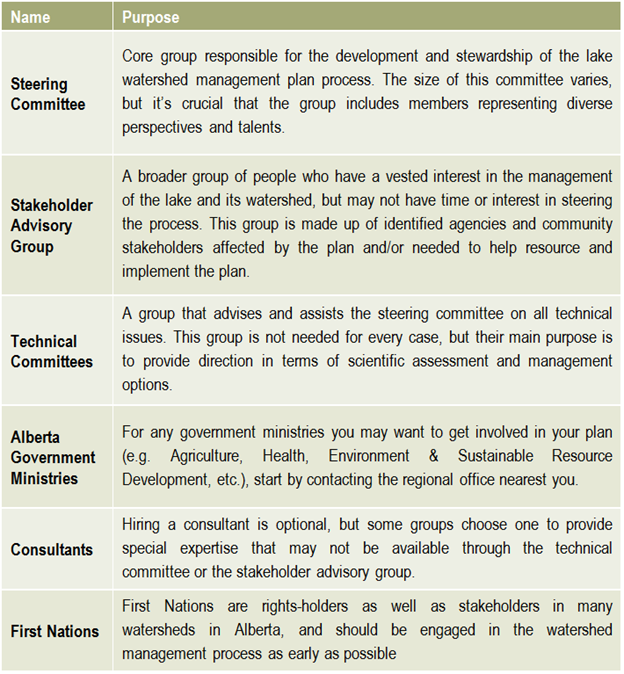
 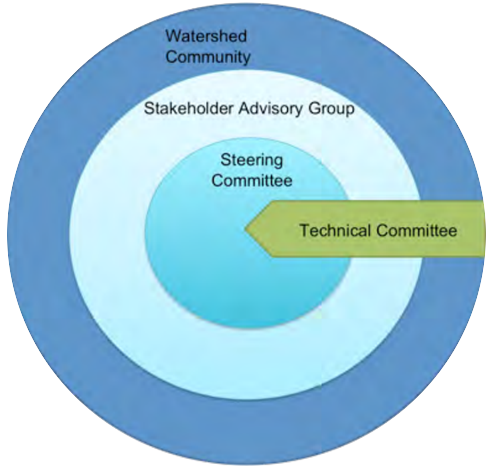 This graphic describes how the various committees and groups will work and interact together. The circle size depicts the approximate number of people involved, and the circles overlapping indicates that some individuals may reside in all of the circles and participate in multiple committees as part of the planning process. The technical committee is shown as an arrow, indicating that it is independent and has relatively few people, and yet it interacts with all of the groups. This graphic may look different depending on the lake and the people involved, and a detailed structure should be agreed upon and described in the plan’s Terms of Reference (Step 6).