
Presentations
**The opinions expressed by external sources are those of the authors and presenters. They do not purport to reflect the opinions or views of the Alberta Lake Management Society or its members.*
01-30-19 In Lake Treatment Seminar
Academic Articles
Stable Isotope Mass Balance of 50 Lakes
Government of Canada
Department of Fisheries and Oceans
Canada-Alberta Environmentally Sustainable Agriculture – stream water quality survey
Environment Canada – Water Survey of Canada
Government of Alberta
Respect our Lakes – Legislation & Regulations
Lake Science and Legislation
Shorelands – Approvals and Regulations
Environmental Monitoring Information Centre
Water For Life Strategy
Watershed Management Resources
Surface Water Data – Lake Trophic Level Maps & raw data for lakes
AEMERA – Alberta Environmental Monitoring, Evaluation and Reporting Agency
Occupational Health and Safety Code
Municipalities
Alberta Association of Summer Villages
Alberta Municipal Districts
Alberta Association of Urban Municipalities
Alberta Association of Municipal Districts and Counties
Stewardship
List of Alberta lake stewardship groups
Watershed Stewardship Directory
Alberta Stewardship Network
Living By Water – Nature Alberta
Cows and Fish – Alberta Riparian Habitat Management Society
Alberta Conservation Association
Alberta Invasive Plants Council
Watershed Protection and Advisory Councils
Athabasca Watershed Council
Battle River Watershed Alliance
Beaver River Watershed Alliance
BRBC – Bow River Basin Council
Lesser Slave Watershed Council
Mighty Peace Watershed Alliance
Milk River Watershed Council Canada
North Saskatchewan Watershed AllianceOldman Watershed Council
Red Deer River Watershed Alliance
SEAWA – South East Alberta Watershed Alliance
Lake Information
Atlas of Alberta Lakes
LakeWatch Reports
Central Alberta Recreational Lakes Initiative
Secchi Dip-In
The Swim Guide
Zooplankton
Lake Levels: Global Surface Water Explorer
Lake Levels: Environment Canada
Lake Levels: Alberta
Non-profit Organizations (for additional resources)
NALMS – North American Lake Management Society
Ducks Unlimited
River Watch
North Saskatchewan Riverkeeper
Water Matters
Society of Canadian Limnologists
BC Lake Stewardship Society
Know Your Watershed
Alberta Water Quality Awareness Day
IceWatch – volunteer monitoring on ice on/off dates for lakes
State of the Watershed Reports:
Reports obtained from various websites have been archived here:
Baptiste Lake
Jackfish Lake
Hubbles Lake
Lac la Nonne
Lac Ste Anne and Isle Lake
Mayatan Lake
Moose Lake
Pigeon Lake
Skeleton Lake
Wabamun Lake
Wizard Lake
Management Plans:
Reports obtained from various websites have been archived here:
Baptiste and Island Lakes
Buffalo Lake
Burnstick Lake
Chain Lakes
Cold Lake
Lac la Biche
Mayatan Lake
Moose Lake
Pigeon Lake
Skeleton Lake
Smoke Lake
Sylvan Lake

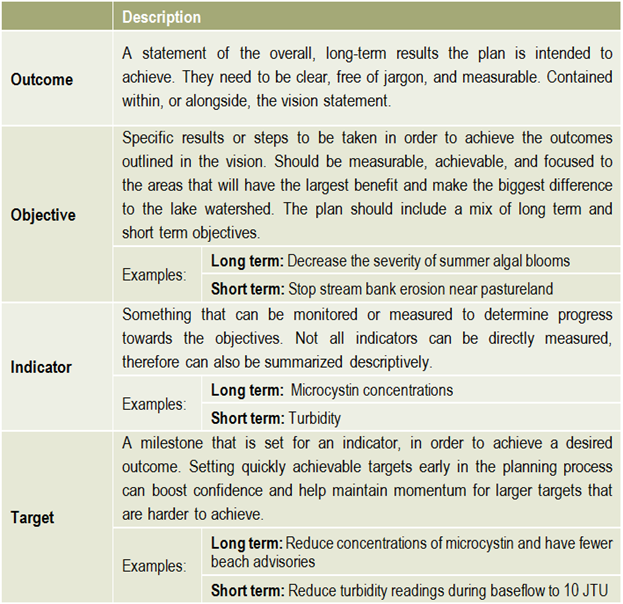
 The members of the steering committee will continue to play a strong role in facilitating and tracking implementation actions. This includes any actions they were responsible for, as well as tracking other committees and sector’s actions and progress made towards achieving the plan’s outcomes. Ongoing communication is essential to successful implementation and achieving outcomes, therefore a regular reporting mechanism could be set up in order to provide regular evaluation of the plan.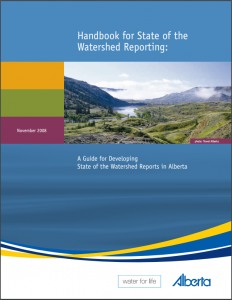

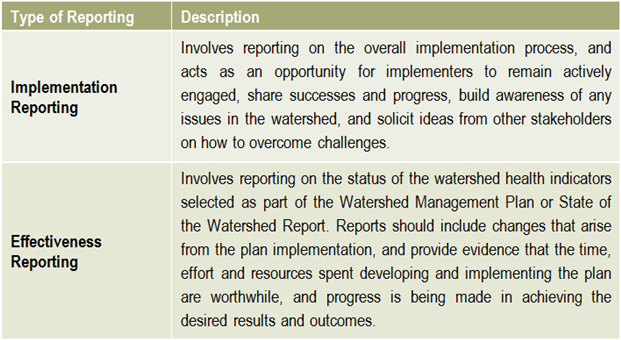 Reporting is an essential component of any watershed management planning and implementation process. There are two main types of reporting that should be shared with stakeholders on a regular basis: implementation reporting & effectiveness reporting.
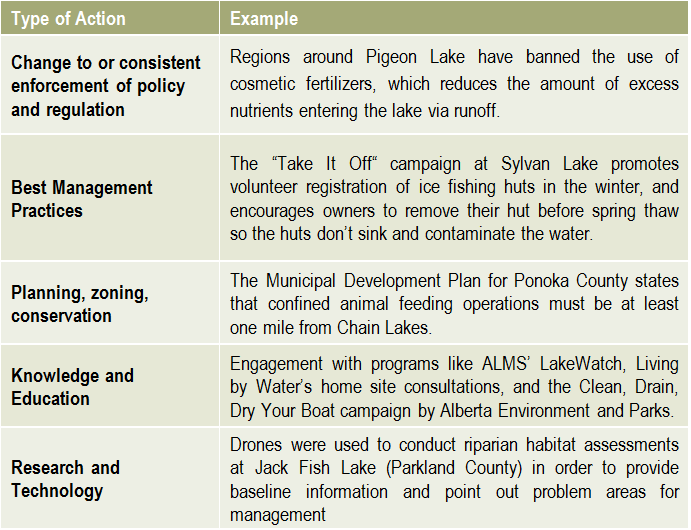 There is no limit to the number or types of lake management actions, but they typically fall into the categories on the right.
 Helpful resources
 The development of a lake watershed management plan provides the guidance needed to implement activities, but the plan cannot be static. Monitoring the performance of your management actions is essential to understanding whether your goals have been met, and whether further actions are needed. Monitoring and evaluating the implementation and effectiveness of a lake watershed management plan allows assessment of progress towards the goals and objectives of the plan, identification of problems and opportunities, and a collection of critical information required when performing a 5 or 10 year review of the plan.
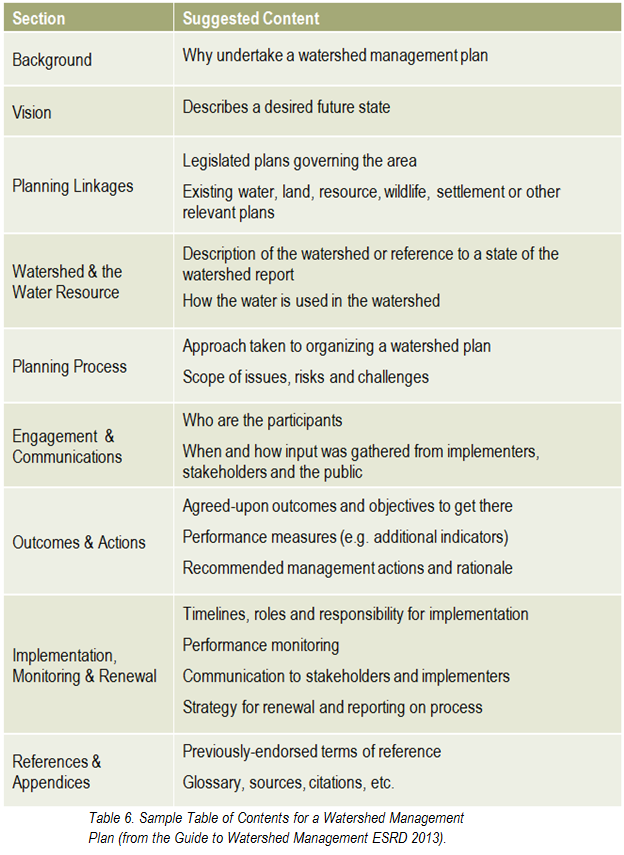
 What has the monitoring results of the plan and of the indicators shown? Is there a need to modify the plan? It is important that the lake watershed management plan does not just sit on a shelf. Information gaps should be addressed, action items need to be managed, completed, and evaluated to best address the needs of the lake. Always keep in mind the vision: if the actions taken are not bringing the lake closer to that vision, then the plan needs to be modified. Consider updating both the state of the watershed and the lake watershed management plans at regular intervals to make sure that the actions taken were achieving the desired outcomes and to evaluate what work still needs to be done.
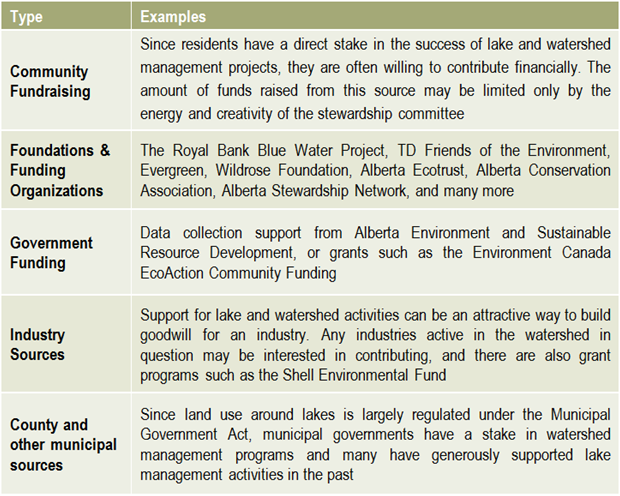 Once a plan has been approved by all affected sectors and officially endorsed and released by the steering committee, then implementation can begin in full. Action projects can be large and comprehensive, or made smaller by staging projects over time or into modules that can be tackled one at a time. Fundraising is an issue that many community groups may find intimidating, but experience with programs such as the Pine Lake Restoration Program (see
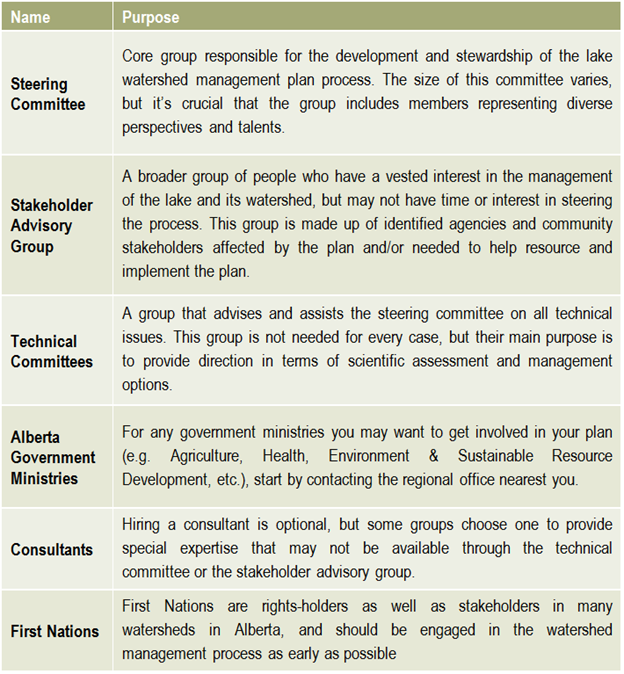
 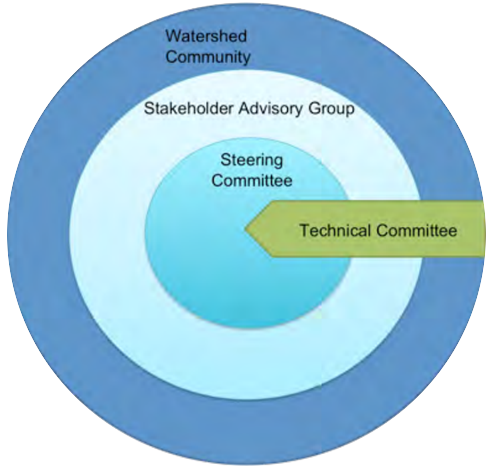 This graphic describes how the various committees and groups will work and interact together. The circle size depicts the approximate number of people involved, and the circles overlapping indicates that some individuals may reside in all of the circles and participate in multiple committees as part of the planning process. The technical committee is shown as an arrow, indicating that it is independent and has relatively few people, and yet it interacts with all of the groups. This graphic may look different depending on the lake and the people involved, and a detailed structure should be agreed upon and described in the plan’s Terms of Reference (Step 6).