

2017 Annual Workshop
September 29-30
Bold Centre, Lac la Biche, Alberta
Each year the Alberta Lake Management Society (ALMS) hosts a two-day workshop to engage stakeholders on issues related to lake monitoring and management.
Lac la Biche acts as the perfect setting for a lake-focused workshop. Of all the counties and municipal districts in Alberta, Lac la Biche falls into the top five in terms of number of waterbodies and kilometers of shoreline. Moreover, ALMS has partnered with Lac la Biche County for the past four years on lake water quality monitoring, and, with recent initiatives such as Sensitive Habitat Inventory Mapping (SHIM) and the formation of the Stewards of Lac la Biche community group, we feel that now is the perfect time to bring our workshop to this important part of the province.
View the final agenda, here.
View the workshop presentations below:
| Block 1: Shorelines | |
| Molly Fyten: Lac la Biche County | Riparian and Wetland Management |
| Dr. Dörte Köster: Hutchinson Environmental Services Ltd. | Sensitive Habitat Inventory Mapping |
| Jenna Curtis: Nature Alberta | Shoreline Naturalization Incentives |
| Block 2: Lake Research | |
| Dr. Patrick Hannington: University of Alberta | e-DNA as a Lake Monitoring Tool |
| Dr. Eric Dillegeard: Hutchinson Environmental Sciences Ltd. | Using Landsat Data for Macro-scale Algae Bloom Detection in Pigeon Lake: 1984-2016 |
| Dr. Cristina Buendia: North Saskatchewan Watershed Alliance | Lake Level Trends in Central Alberta |
| Session 3: Stewardship | |
| Breda Muldoon: North Saskatchewan Watershed Alliance | Lake Management in the North Saskatchewan River Basin |
| Kathleen Bruce: Long Lake Cottage Owners Association | Long Lake Cottage Owners Association Initiatives - Presentation Unavailable |
| Bob Gibbs: Pigeon Lake Watershed Alliance | Pigeon Lake Watershed Management Plan 2017: Objectives and Recommendations |
| Jane Dauphinee: Working with Municipalities for Collaborative Watershed Planning | Working with Municipalities for Collaborative Watershed Planning |
| Carolyn Campbell: Alberta Wilderness Association | The Lakes of Lakeland: An Inspiring Wilderness |
| Block 4: Provincial Topics | |
| Alina Wolanski: Alberta Environment and Parks | Peace Region Lakes: Report Card and Indexes |
| Anuja Ramgoolam: Alberta Water Council | Advancing Lake Watershed Management in Alberta |
| Laura Redmond: Alberta Lake Management Society | Alberta Lake Management Society Updates |
| Block 4: Provincial Topics | |
| Emily Drystek: Alberta Environment and Parks | Whirling Disease in Alberta |
| Kerri O'Shaugnessy: Cows and Fish | Beavers: Thinking Beyond the Dam |
| Dave Prescott: Alberta Environment and Parks | Western Grebe Management and Recovery in Alberta |
| Field Tours | |
| Lac la Biche Biological Nutrient Removal Facility | |
| Sir Winston Churchill Provincial Park | |
| Mission Historic Site | |
Thank-you to our sponsors!



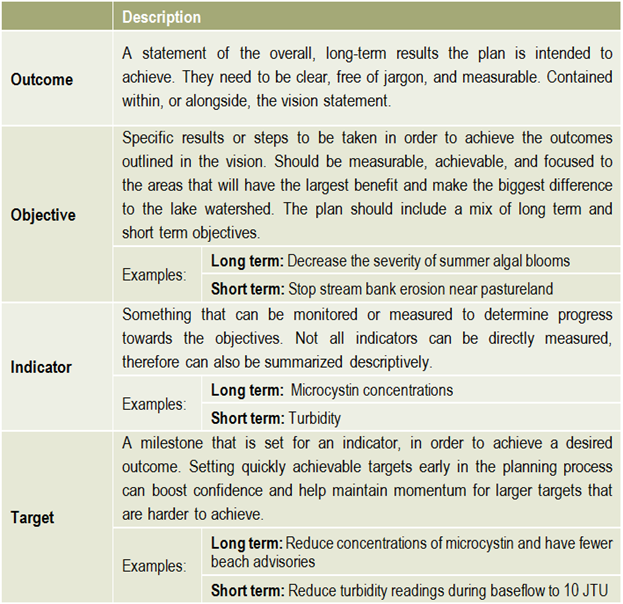
 The members of the steering committee will continue to play a strong role in facilitating and tracking implementation actions. This includes any actions they were responsible for, as well as tracking other committees and sector’s actions and progress made towards achieving the plan’s outcomes. Ongoing communication is essential to successful implementation and achieving outcomes, therefore a regular reporting mechanism could be set up in order to provide regular evaluation of the plan.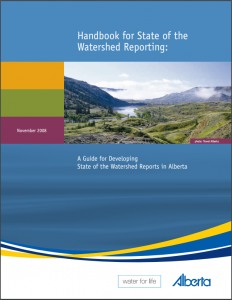

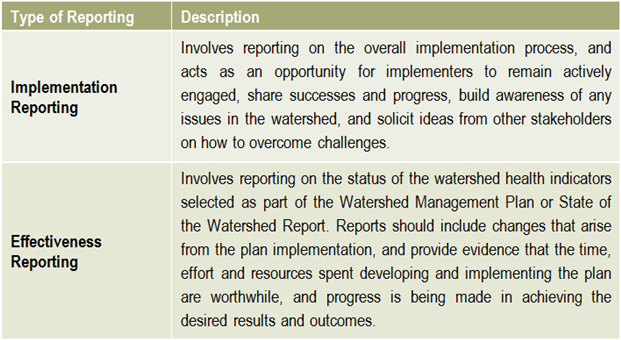 Reporting is an essential component of any watershed management planning and implementation process. There are two main types of reporting that should be shared with stakeholders on a regular basis: implementation reporting & effectiveness reporting.
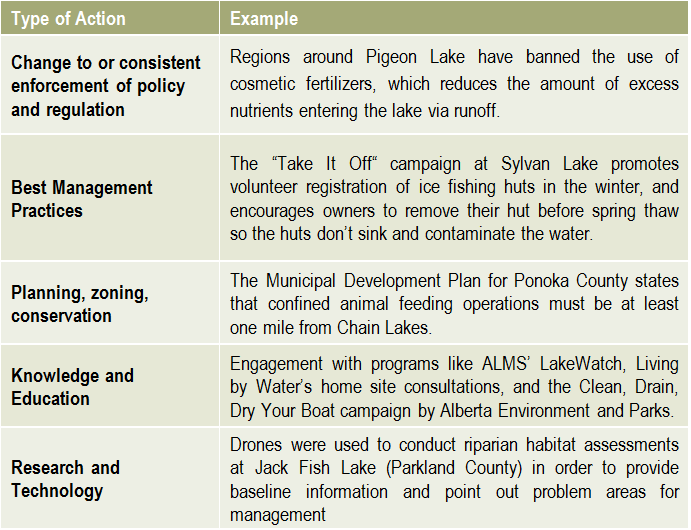 There is no limit to the number or types of lake management actions, but they typically fall into the categories on the right.
 Helpful resources
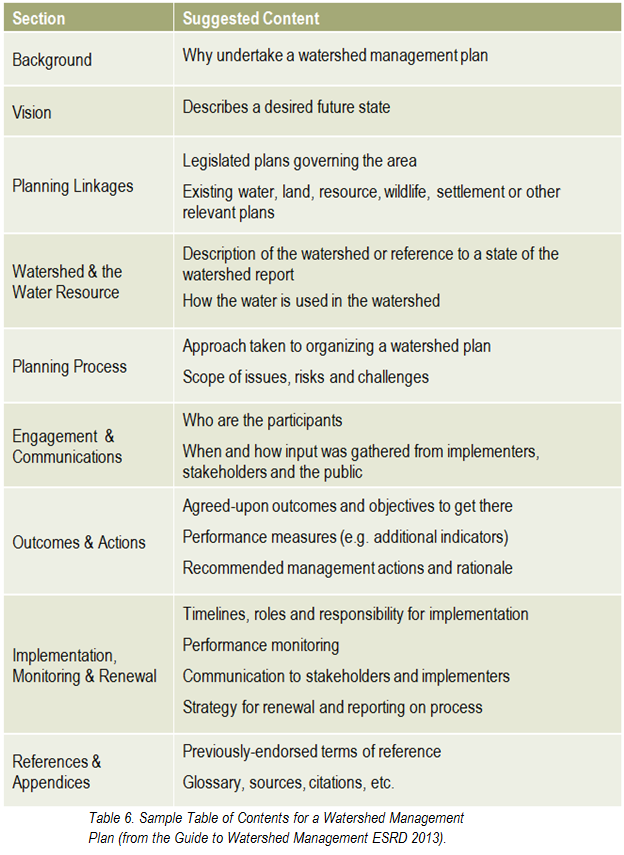
 The development of a lake watershed management plan provides the guidance needed to implement activities, but the plan cannot be static. Monitoring the performance of your management actions is essential to understanding whether your goals have been met, and whether further actions are needed. Monitoring and evaluating the implementation and effectiveness of a lake watershed management plan allows assessment of progress towards the goals and objectives of the plan, identification of problems and opportunities, and a collection of critical information required when performing a 5 or 10 year review of the plan.
 What has the monitoring results of the plan and of the indicators shown? Is there a need to modify the plan? It is important that the lake watershed management plan does not just sit on a shelf. Information gaps should be addressed, action items need to be managed, completed, and evaluated to best address the needs of the lake. Always keep in mind the vision: if the actions taken are not bringing the lake closer to that vision, then the plan needs to be modified. Consider updating both the state of the watershed and the lake watershed management plans at regular intervals to make sure that the actions taken were achieving the desired outcomes and to evaluate what work still needs to be done.
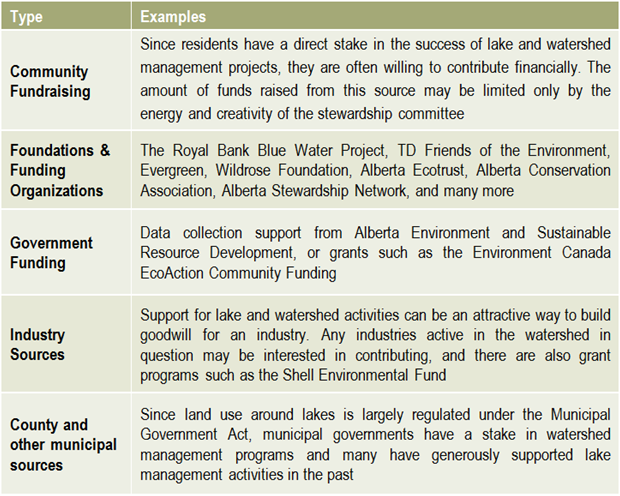 Once a plan has been approved by all affected sectors and officially endorsed and released by the steering committee, then implementation can begin in full. Action projects can be large and comprehensive, or made smaller by staging projects over time or into modules that can be tackled one at a time. Fundraising is an issue that many community groups may find intimidating, but experience with programs such as the Pine Lake Restoration Program (see
 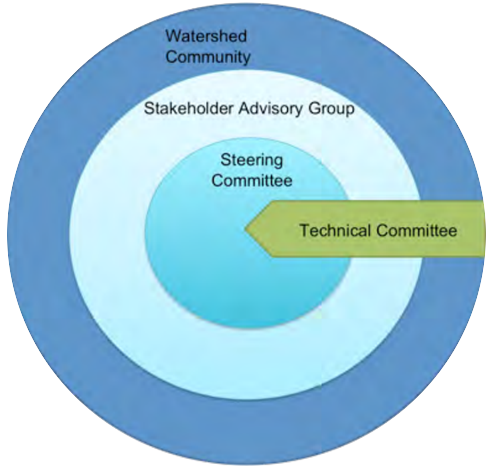 This graphic describes how the various committees and groups will work and interact together. The circle size depicts the approximate number of people involved, and the circles overlapping indicates that some individuals may reside in all of the circles and participate in multiple committees as part of the planning process. The technical committee is shown as an arrow, indicating that it is independent and has relatively few people, and yet it interacts with all of the groups. This graphic may look different depending on the lake and the people involved, and a detailed structure should be agreed upon and described in the plan’s Terms of Reference (Step 6).
Recent Comments